
.avif)
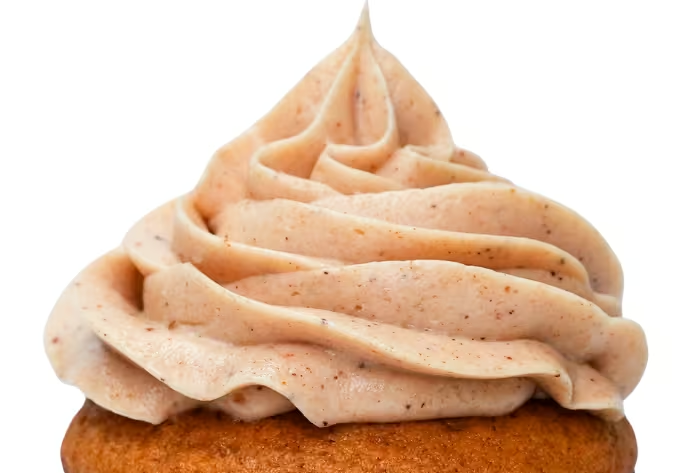
Cream Cheese Buttercream (with Tub-Style Soft Cream Cheese)


Step by step:
coming soon!
Video
Honors Members Section
This extra material is accessible to Sugarologie Honors members.
Become a member to view extended research notes, technique analysis, and supplemental materials! Learn more about Sugarologie Honors here.
Already a member?
Before starting the recipe, please read this!
Measure by weight, if possible.
Measuring by weight is the best way for you to replicate my recipes. I develop recipes using ingredients (even liquids) measured in grams, which is why you see them listed first in the recipe cards. For measurements under 5 grams, I will typically only list the volumetric measurements (teaspoons, etc.), as most home scales are not precise for such small weights.
In most cases, I have converted grams to volumetric measurements (aka US customary units) for bakers who prefer this method. However, the measurements are not as precise and may have awkward proportions. The recipes should still work, but for the ultimate precision, try to use weight.
This is the OXO scale I use daily. I also purchased this budget version of a good scale, which I keep at my Mom’s house for baking. If you’re interested in other tools I use for my baking, I’ve compiled a list here.
Use room temperature ingredients.
All my ingredients should be used at room temperature, or 65-75 °F/18-24 °C. I will always indicate if you need something outside this range. If no details are given, room temperature is the default.
Pay attention to the ingredient descriptions.
I try not to be brand-specific, but I will always note an interesting result from a type of ingredient, be it negative or positive.
A specific note regarding salt: I use Diamond Crystal Kosher salt for everything on this site except for frostings. In frostings, you want the salt to dissolve more easily, and kosher salt tends to leave granules behind. If you substitute table salt (more finely granulated) for recipes that list kosher salt, you must use half the volume indicated in my recipes.
Substitutions are hard.
That said, substitutions aren’t impossible but can be the toughest part of recipe development. Small swaps, like reduced-fat milk (2% fat) for whole milk (3.5% fat), usually work fine. However, bigger changes—such as replacing oil with applesauce or sour cream with Greek yogurt—can significantly impact texture and density.
Be wary of general, all-purpose substitutions in baking; I find that usually there is never a one size-fits-all solution. I carefully select ingredients for my recipes, so for the best results, start with the original recipe and modify with caution.
Read all the recipe instructions before beginning.
I’m in the “Pre-read the Chapter before Class Lecture” club... and I invite you to join! Baking new recipes can be intimidating, so let’s set you up for success. I want you to think about timeframes. Most fillings and frostings can be made ahead of time, and give you an extra day for mental space. Also, as you become a more proficient baker, you can anticipate and recognize steps. (“Oh, this has a meringue step, so I’ll need an extra clean bowl…” etc.) Ensure you go down the ingredient list and have everything at the right temperature.

.avif)
.avif)
.png)

- 339 g (1 ½ cups) unsalted butter, cold from fridge
- 255 g (2 ⅛ cups) powdered (confectioner's) sugar, sifted if lumpy
- 1 teaspoon vanilla extract
- Small pinch fine sea salt
- 0.3 g (⅛ teaspoon) lactic acid powder, food-grade (optional)*
- 113 g (½ cup) full-fat tub-style cream cheese (soft/spreadable cream cheese)**, cold from fridge
- 339 g (1 ½ cups) unsalted butter, cold from fridge
- 255 g (2 ⅛ cups) powdered (confectioner's) sugar, sifted if lumpy
- 1 teaspoon vanilla extract
- Small pinch fine sea salt
- 0.3 g (⅛ teaspoon) lactic acid powder, food-grade (optional)*
- 113 g (½ cup) full-fat tub-style cream cheese (soft/spreadable cream cheese)**, cold from fridge
- 509 g (2 ¼ cups) unsalted butter, cold from fridge
- 383 g (3 cups + 3 tablespoons) powdered (confectioner's) sugar, sifted if lumpy
- 1 ½ teaspoons vanilla extract
- Small pinch fine sea salt
- 0.45 g (⅛ + 1/16 teaspoon) lactic acid powder, food-grade (optional)*
- 170 g (¾ cup) full-fat tub-style cream cheese (soft/spreadable cream cheese)**, cold from fridge
Note: You can use either a stand or hand mixer, although I prefer the hand mixer. This gives you greater control and reduces the risk of overmixing the buttercream. This frosting also relies less on aeration than many buttercreams; the cream cheese naturally lightens the texture, so the extra aeration a stand mixer can provide isn’t necessary. Also, to prevent overmixing, I will have you manually fold the cream cheese in with a spatula in step 3.
- Smooth out the butter.
Cut the cold butter into chunks into a large mixing bowl. Cream until smooth and there are no visible lumps. - Add the powdered sugar in increments.
Add about a third of the powdered sugar (no need to be exact) and mix on low. Once combined, add the next third and repeat. With the final addition, mix in the vanilla, pinch of salt, and lactic acid powder (optional); cream cheese is already salted, so adjust to taste at the end.
If using a hand mixer, this part takes the longest; I use a scraping motion to help it come together faster. - Add cream cheese and smooth out the buttercream.
Cream cheese spread that comes in a tub is usually soft but if you find yours is a bit clumpy, give it a stir in another clean bowl. I usually add the cream cheese, straight from the fridge right into the butter mixture because it’s pretty soft, even when chilled.
Add the smooth, cold cream cheese to the butter-sugar mixture. Use a spatula to carefully stir the cream cheese in. Avoid overmixing to prevent the frosting from becoming too thin.
Use immediately.

Recipe Card - Adriana's Notes
*Lactic acid powder is a great way to add acidity without adding any extra water/fats/etc. Lactic acid is one of the primary acids produced by lactic-acid bacteria during dairy fermentation, so the powdered acid is an effective way to boost the characteristic tang without adding water or fat to the frosting. Just ensure the one you buy is “food-grade.” I got mine from Amazon, here.
**Cream Cheese Spread (I use Philadelphia brand) comes in a tub. Compared to the cream cheese product that comes solid in a brick, the tub-spread version does have a more spreadable, soft texture likely due to the higher ratio of water to fat and different gums. If you’re using the brick-style cream cheese, you’ll need a different recipe, located here.
Recommended Sugar Lab Recipes + Experiments

Got room for more dessert?
Subscribe to my Crumby Data newsletter! I share behind-the-scenes looks at recipe development, flavor testing for the Cakeculator, and life as a content creator. It’s free, lands in your inbox every few weeks, and you can unsubscribe anytime...no strings attached :)
Feel free to take a look at previous newsletters here!

.ico)