
.avif)
No-leak Brown Sugar Cinnamon Filling for Cinnamon Rolls


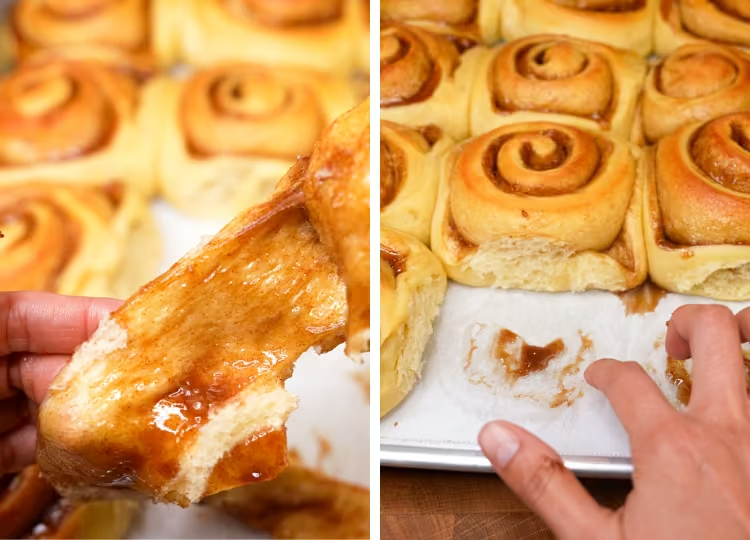
If you’ve ever experienced your sugar and cinnamon filling leaking out of your cinnamon rolls, this recipe is for you. By using a pre-gelatinized starch paste, we can create a glue that holds the sweet filling in place even before the bun starts baking. This yields a moist, gooey filling that covers the entire interior of your cinnamon bun swirl, keeping the bun moist and squishy for longer thanks to its high water content.
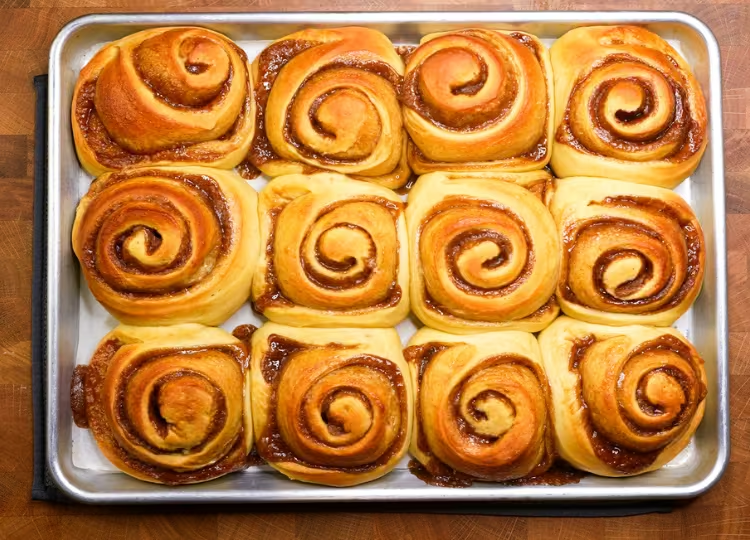
Brown Sugar, ground cinnamon, and butter are a classic filling for all types of yeasted rolls, including cinnamon buns. Because butter has a low melting point, and because the sugar combines with the moisture from the rolls, I’ve always experienced the filling falling out of the buns. This is great if you plan to flip the buns for serving, in which case you have some wonderful sticky buns, but I was really looking for a cinnamon roll with a good dose of that brown-sugar-cinnamon-spiced gooeyness inside the bun.
What is the flavor/taste/texture of this brown sugar cinnamon paste?
The flavor is molasses-forward sweetness from the brown sugar with a spicy cinnamon kick. There is a mild sweet-rice flavor from the starch, but it is very subtle.
What ingredients will you need to make this brown-sugar-cinnamon filling?
1 | SWEET RICE FLOUR
This flour is made from glutinous (or sticky) rice, which contains a high level of amylopectin. This is what gives the final paste a chewy, cohesive texture. I use the Mochiko brand.
2 | WATER
This is the sole liquid source that will hydrate the starches in the sweet rice flour. It’s also going to dissolve the brown sugar.
3 | BROWN SUGAR
You can use either light or dark brown sugar, but I love dark for the filling because it contributes a rich molasses flavor.
4 | GROUND CINNAMON
The primary spice for this filling is cinnamon, but you are free to use whatever spice combination you like. I sometimes go for ground cardamom or a bit of nutmeg.
How much filling does your recipe make?
I have two quantities below. The important thing to note is that if you're making my recipe, you'll need a bigger pan size than if you were just using plain old cinnamon brown sugar filling.
For the ½ cup amount, you can fill 6 large rolls. For my milk bread roll recipe, use a 9x13 inch (23 x 33cm) rectangular pan.
For the 1 cup amount, you can fill 12 large rolls. For my milk bread roll recipe use a 18 x 13 inches (45 x 33 cm)or half sheet pan.
You can find my cinnamon roll recipe here.
Follow the instructions and instead of the brown sugar filling, you'll use this paste in its place. Proceed with the recipe as written using the pan modifications above. It will seem like the rolls have almost too much space, especially if you're used to smooshing rolls inside a smaller pan, but don't worry, it will work. The rolls need room to grow outwards instead of upwards for this filling to work properly.
Step by step:
coming shortly
Video
Honors Members Section
This extra material is accessible to Sugarologie Honors members.
Become a member to view extended research notes, technique analysis, and supplemental materials! Learn more about Sugarologie Honors here.
Already a member?
Before starting the recipe, please read this!
Measure by weight, if possible.
Measuring by weight is the best way for you to replicate my recipes. I develop recipes using ingredients (even liquids) measured in grams, which is why you see them listed first in the recipe cards. For measurements under 5 grams, I will typically only list the volumetric measurements (teaspoons, etc.), as most home scales are not precise for such small weights.
In most cases, I have converted grams to volumetric measurements (aka US customary units) for bakers who prefer this method. However, the measurements are not as precise and may have awkward proportions. The recipes should still work, but for the ultimate precision, try to use weight.
This is the OXO scale I use daily. I also purchased this budget version of a good scale, which I keep at my Mom’s house for baking. If you’re interested in other tools I use for my baking, I’ve compiled a list here.
Use room temperature ingredients.
All my ingredients should be used at room temperature, or 65-75 °F/18-24 °C. I will always indicate if you need something outside this range. If no details are given, room temperature is the default.
Pay attention to the ingredient descriptions.
I try not to be brand-specific, but I will always note an interesting result from a type of ingredient, be it negative or positive.
A specific note regarding salt: I use Diamond Crystal Kosher salt for everything on this site except for frostings. In frostings, you want the salt to dissolve more easily, and kosher salt tends to leave granules behind. If you substitute table salt (more finely granulated) for recipes that list kosher salt, you must use half the volume indicated in my recipes.
Substitutions are hard.
That said, substitutions aren’t impossible but can be the toughest part of recipe development. Small swaps, like reduced-fat milk (2% fat) for whole milk (3.5% fat), usually work fine. However, bigger changes—such as replacing oil with applesauce or sour cream with Greek yogurt—can significantly impact texture and density.
Be wary of general, all-purpose substitutions in baking; I find that usually there is never a one size-fits-all solution. I carefully select ingredients for my recipes, so for the best results, start with the original recipe and modify with caution.
Read all the recipe instructions before beginning.
I’m in the “Pre-read the Chapter before Class Lecture” club... and I invite you to join! Baking new recipes can be intimidating, so let’s set you up for success. I want you to think about timeframes. Most fillings and frostings can be made ahead of time, and give you an extra day for mental space. Also, as you become a more proficient baker, you can anticipate and recognize steps. (“Oh, this has a meringue step, so I’ll need an extra clean bowl…” etc.) Ensure you go down the ingredient list and have everything at the right temperature.

.avif)
.avif)
.png)

Stay-put Brown Sugar Cinnamon Filling
- 20 g (2 tablespoons) sweet rice flour
- 58 g (¼ cup) water
- 80 g (⅓ cup + 1 tablespoon) brown sugar (I like dark)
- 3 g (2 teaspoons) ground cinnamon
- 20 g (2 tablespoons) sweet rice flour
- 58 g (¼ cup) water
- 80 g (⅓ cup + 1 tablespoon) brown sugar (I like dark)
- 3 g (2 teaspoons) ground cinnamon
- 40 g (4 tablespoons) sweet rice flour
- 118 g (½ cup) water
- 160 g (⅔ cup + 2 tablespoons) brown sugar (I like dark)
- 6 g (4 teaspoons) ground cinnamon
- Make rice paste.
Microwave method:
In a medium microwave-safe bowl, stir the water and rice flour until no clumps remain. Wrap the bowl tightly in plastic wrap. Microwave on high power (1200 Watts) for 30 seconds, then carefully remove the bowl and plastic. Stir with a small spatula to evenly distribute the thickened rice flour. It will still be a little watery, so repeat this process one more time until the paste is thick and glossy when stirred.
Stovetop method:
In a small pan, add the water and rice flour, and stir until no clumps remain. Cook on medium-low heat until the paste thickens into a pudding-like consistency. Pour the mixture into a small bowl. - Add brown sugar and cinnamon.
Stir the paste vigorously to enhance its stickiness.
Stir in the brown sugar until it is combined, and the mixture is sticky, and you can no longer feel the sugar granules.
Stir in the cinnamon. - Let the paste cool slightly.
Cover back up with plastic wrap to prevent moisture loss, and let it cool slightly before spreading onto the dough.
It’s best to use this paste a bit warm, as it spreads more easily over the soft cinnamon roll dough. You may get some gaps and patches as you spread it - don’t worry, because instead of regular techniques where we bank on some of the filling dripping out of the rolls, almost all of the filling will live inside the rolls, giving it a strong spicy sweetness throughout.

Recipe Card - Adriana's Notes
.avif)
.avif)

Got room for more dessert?
Subscribe to my Crumby Data newsletter! I share behind-the-scenes looks at recipe development, flavor testing for the Cakeculator, and life as a content creator. It’s free, lands in your inbox every few weeks, and you can unsubscribe anytime...no strings attached :)
Feel free to take a look at previous newsletters here!

.ico)